
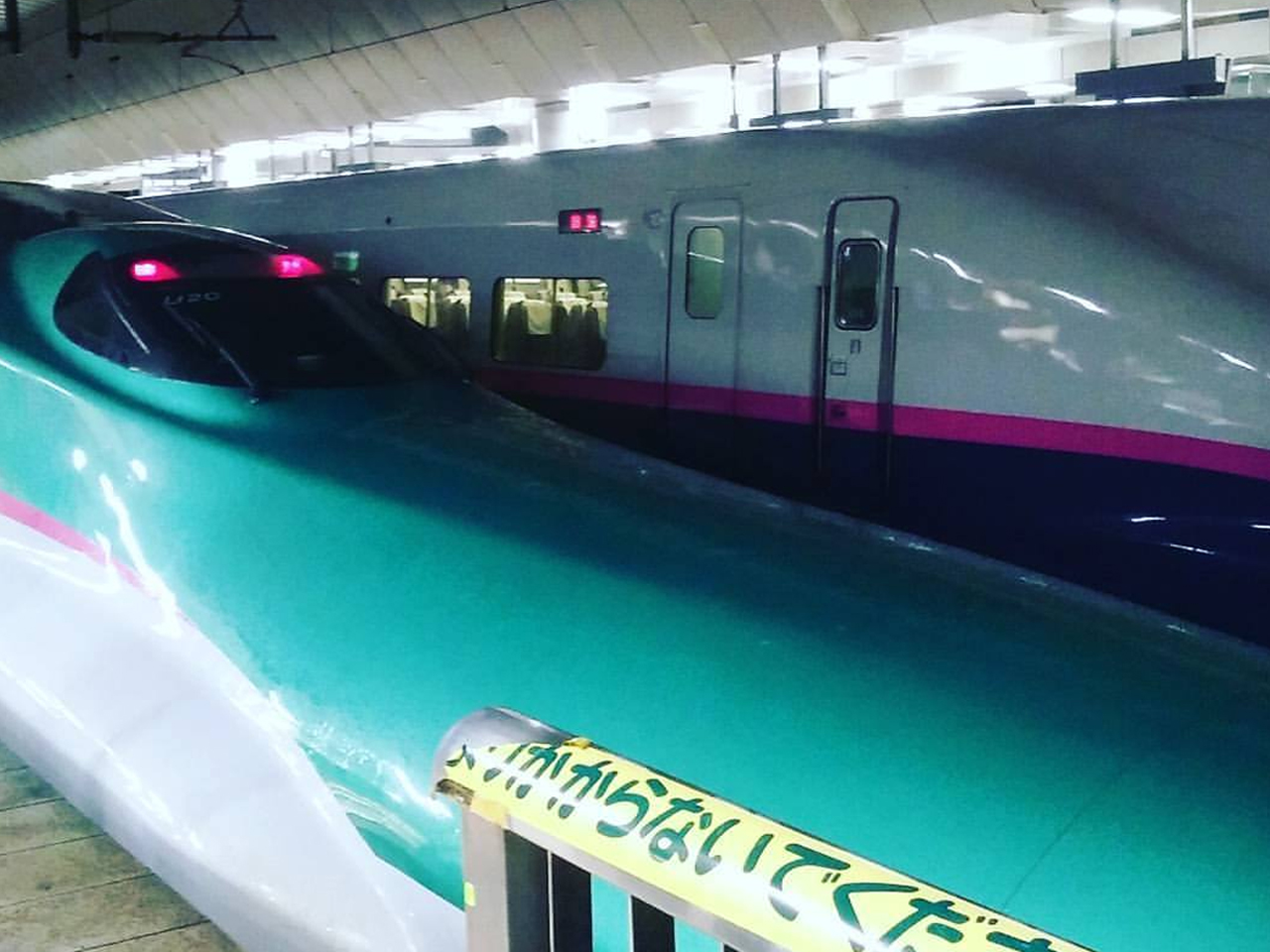
We headed out of the apartment earlier than usual. After dropping off the key, we headed to the Shinjuku station, where we took the JR line to the Tokyo Station. From there, we would take the shinkansen to Kyoto. We arrived at the ticket booth to reserve our seats, only to find out that the next train was filled, but we were able to get two seats together on the train leaving an hour later. We were scheduled to meet our guide Motoko in Kyoto around noon, and the train that we had been booked on was scheduled to arrive a little before then. So we would be right on time.
I received a message from my friend Sonoko, which said that if we sit on the right side of the train to Kyoto, we would be able to see Mount Fuji as the train traveled passed. Unfortunately, the seats that we had been assigned were on the left side of the train and there weren’t seats available on the right. I had hoped that perhaps we would be lucky on the way back.

While we waited for our train, we decided to walk over to a Danish themed coffee shop nearby named Madame Bla. The outside of the storefront was open, but the walls surrounding the kitchen, looked like the outside of a blue house with outdoor windows and doors. There were tables lining the right side and we walked over to find a place to sit. The coffee shop opened on that side to a bookstore and there was a shelf of children’s books on the wall right on the other side of our table. I started looking through the shelf and thought about buying one of these books to read to Hendrix, if I ever actually learned to read and speak Japanese. As I thought about it, I knew that our trip still had a few days left to it, so I thought that it was best to wait before I added books to my already defective backpack.
After we ate some breakfast, we gathered our possessions, and battled the millions of business people who were getting on and off trains and heading to work. At some points in our journey, we would have to cross through massive crowds of people to get to the correct concourse, completely ruining the flow of oncoming traffic. I always try to put my feet in the shoes of the people that are trying to get to work and then imagine two American tourists pushing a stroller against the current, looking like idiots, and shake my head.
We arrived at the shinkansen concourse then to the elevator up to the correct platform, where the direct train to Kyoto soon arrived. The train was crowded as usual and while there was no one sitting next to us at first, a man in a suit got on the train after a few stops, then fell asleep next to me. It was going to be a long ride and while we wanted to get comfortable, about halfway through the trip, Escher had a breakdown and started crying uncontrollably. There were certain cars on the train where there were nursing and changing stations for mothers, and Elizabeth took Escher into one to try to calm him down. She came back after a while, then handed him off to me. I took him to a section in-between cars, then rocked him with my headphones on listening to music. Eventually, he got tired of crying and fell asleep, but it took a little while for it to happen. I brought him back to my seat and held him the rest of the way to Kyoto.
Meeting Motoko

When we arrived at Kyoto Station, the plan was to meet up with Motoko, our new tour guide. How we came to be connected to Motoko was sort of a mystery. While I was trying to connect with guides in Tokyo, waiting weeks to hear back, I did a Google search to see if there was a similar guide service in Kyoto. The website looked a little dated. Instead of having a contact form on their website, you had to copy and paste a list of questions into an email, then send it to a Yahoo email address. I was sure that my email would go unreceived and I would find myself just sending my information into an email box that was no longer in use. However, I received a similar automated email back as the agency in Tokyo. This time, however, within days of my request, Motoko emailed us with a plan in place. It would still be another week or so before I heard from Shiro, so I was really impressed with the promptness of getting things locked in with Motoko.
Motoko was married and had a teenage daughter. They lived about an hour train ride away, in a city south beyond Osaka. Motoko and I corresponded back and forth a few times, making sure that she was able to plan out every possible detail of our 2 half day tours. Motoko was really concerned about making sure that the baby was taken care of and also that Elizabeth had vegetarian food to eat. She was very organized and detail oriented. She took it very seriously, that we have an amazing time in Kyoto.
The plan was for us to meet Motoko at the Central Gate of the JR Kyoto station at 12:20. The problem that we ran into was that there were two Central Gates. We arrive in Kyoto, got off the shinkansen train, then walked into the concourse of the station. It looked as though, we had arrived at “the Central Gate” almost instantly. The crowd was pretty intense, as it had been in Tokyo, and I was concerned that we might not even find Motoko amongst all the people. The good thing about looking like a lost American with a baby, however, is that you stand out like a sore thumb against the thousands of people, who all seem to know where they are going. We crossed through the turnstile out of the shinkansen area into what we thought was the Central Gate, but we didn’t see anyone who appeared like they were looking for us.
We were looking for a sign that said, “Holtwick” or “Christopher”, but the only people that we saw holding signs, were holding signs that written in Japanese, and I was able to read them. We happened to see an elderly woman, who looked like she was looking for someone as well. I approached her and said, “Shamemashin, are you Motoko?” the woman smiled and shook her head, no. We were left back at square one. As we continued walking with the crowd toward another sign that said, “Central Gate” we arrived in a huge wide open space. We were on what looked to be the third floor of the Central Gate.
We looked around the interior of the station, which matched the beauty of some of the most marvelous train stations that we have visited throughout the world. This was up there with Grand Central in New York and the Berlin station in Germany. While all three are remarkable in their own way, they all make you feel like you have arrived in an amazing, heavenly place. There were interesting angles in the architecture and windows across the ceiling. We looked out beyond the escalators, passed the open air restaurants, and used our super elevator spotter sight to find a way to get to the ground floor with our roller bags and the stroller.
Once we found an elevator and made it to the ground floor, now the search was on to find Motoko amongst the middle age, Japanese population that surrounded us. It was already 12:40 and I just kept thinking that I had let her down by not keeping my promise to meet her at a certain time. For the perfectionist in me, 20 minutes was significantly too late to be considered on time. Half of the day had been spent on a train, and every minute that passed was a few minutes more of Kyoto that we would have to miss.
We spotted a pay phone and I remembered that I had Motoko’s phone number in an email that she had sent me. With the help our handy pocket wi-fi, I was able to connect to the internet, retrieve my email, and find the number. Just then someone arrived at the phone bank as I was walking over. A young woman was struggling to get her call to go through. I stood by anxiously and waited for my turn. I started pulling out my coins and counting them out to hopefully make this call. The young woman at the phone moved on and I started putting coins into the phone, only for my call to fail to connect.
Just then, I heard an outburst from Elizabeth and another woman behind me. I turned around and there was Elizabeth and Motoko both smiling from ear to ear. Motoko was so moved by the moment, that she started to laugh and cry at the same time. She apologized profusely and gave both Elizabeth and I a big hug. It calmed her down a little and we apologized back for arriving late. It truly was an emotional moment. As we told her about trying to call her and how we looked around upstairs, she got even more emotional. We let her know that it was okay that we didn’t meet up right away. We told her that we were okay, but she truly felt sad and guilty, as if she had let us down. She thought that we might have been angry or felt lost or maybe we just wouldn’t know how to handle being the situation. The good thing, however, was that we had been lost and confused in a lot of our travels. So it was us who felt bad for her, because of our ineptness to confirm the exact meeting location.
The plan from this point was for us to take our baggage to the hotel, drop it off before check-in while we explored the city (which Motoko had called to confirm was possible), then come back and meet up with her. At that point, we would get some lunch, then head out to Fushimi Inari Taisha Shrine. Motoko walked with us to the bus turn around, outside the Central Gate of the station. There was a ticket machine, which Motoko took us over to. She told us that instead of using the Pasmo card, that it would be cheaper for us to just purchase some 24-hour unlimited bus passes. This would allow us to get on and off the buses as much as we wanted. Instead of paying to go to the hotel and back twice that day, we could pay for the trip once, then use the same pass into the next day.
After purchasing the passes at the machine, Motoko brought us to the correct stop, where we waited for our bus to circle around. The hotel was 4 stops away from the station and it only took us about 10 minutes to get there, instead of the 30-60 minute walk that I had originally proposed. The bus let us off at a stop just across the street from the hotel. This was convenient, because we only had to carry our bags and the baby another 500ft at the crosswalk.
The Urbain Kyoto Hotel was only a building away from the main street, but far enough away that you couldn’t really hear traffic going by. We walked through the tall, glass, automatic double doors and walked up to the front desk. We explained our situation to the desk manager, that we were coming in a little early before our check in time, to drop off our bags. The desk manager gave us a numbered tag, and we handed over our roller bag, my camera bag, and my backpack, which was wrapped in a belt. We asked the manager, if she knew where the bus stop was to get back to the train station. She explained that there wasn’t one. I didn’t think that it was true, but Elizabeth was pretty sure that we could trust her, so when we went out the door we attempted to hail a cab.
We did think that it was a little strange bringing Escher into the backseat of a cab with no child seat, but we had consulted Motoko before our trip and she seemed to think that everything was going to be okay. We hailed a cab and a Toyota Crown pulled to the side of the road to pick us up. The driver could see that we were going to need some help. A man in his late-50’s, wearing a suit and tie, stepped out of the car, and helped us put the stroller in the trunk. Once we all got into the car, he took us to the station, which was only about 2 miles away.
When he dropped us off in front of the station, we walked passed the circling buses, towards the train station. Just before we reach the doors to the station, we were stopped by some elementary school kids, who were taking surveys. They were stopping people who looked like they were traveling, and asked them questions, in order to practice their English. Always one to help someone out, especially kids, I was happy to stop and answer whatever questions they asked. There were about 5 children with their teacher and each child took turns asking us, where we were from, our names, and sights in Kyoto that we most wanted to see. After they finished asking their questions, they thanked us, and gave each of us a bookmark that had kanji writing on it. We would come to find out from Motoko, that the bookmarks said, loyal and kindness, respectively.
We entered the station and found Motoko right where we had left her. By this time, she was hurrying us along to get to the restaurant, where she had made reservations for us to eat. We alerted Motoko that at some point, we needed to stop to purchase a new backpack, and a new pacifier for Escher. She seemed pretty familiar with Kyoto, in general, but she couldn’t think of any stores nearby that would have what we were looking for. We took an elevator down, right outside the station, then ended up entering a mall, where there was a food court of sorts with numerous sit down restaurants. We walked around for a bit, until Motoko brought us to a restaurant called Kineya Kyoto Porta. As we arrived, almost as if she was a regular, we walked right in passed the people at the door. In a restaurant that was completely full, there was one table set aside specifically for us like in Goodfellas.
We sat down in the booth, then looked through the menu. Motoko helped us make sure that Elizabeth got a dish without meat. The restaurant specialized in ramen soup. I picked out something that had some pork, a soft boiled egg, noodles, and a few vegetables. While I was getting out my camera, to keep up with the habit of taking a photo of every dish that I ate abroad, I found out that the battery wasn’t in the camera. When I packed everything up in the morning, I must’ve packed the battery in with the charger, in my backpack, back at the hotel.
Now I very well could’ve just relied on my smartphone to take low quality photos, but I felt like it was really important that I capture Kyoto in high definition. I mentioned to Motoko that I didn’t have the battery. I didn’t want to have to go back to the hotel, because I didn’t want to take anymore time away from our tour, so I asked if there was a camera store in the mall. She said that she didn’t think so, but there was a store nearby that sold cameras.
Before our food arrived, Motoko, who wanted to make sure that she provided us with an educational experience, brought out a folder that contained different Kyoto facts and historic sites. She flipped through the tourism packet with us, then told us a little bit about her plan for the next two days.
After we finished eating, we started walking through the mall to see if we could find a pacifier, backpack, or a camera battery. Eventually we made it outside to a massive department store that seemed to have everything we ever could’ve imagined. The first floor alone seemed to be exclusively focused on cameras and camera equipment. We found a clerk, who brought us over to where the batteries were being sold, and since I had a Canon, they found it immediately. I asked them if the battery was charged already, so that I could use it right away. They informed me that unfortunately, it wasn’t.
Elizabeth, Motoko, and I stopped to have a short a chat. Since they still had to find stuff for the baby, I thought that it would be best for me to just go back to the hotel, then meet them at the train station. They agreed. I ran to get on the bus, then arrived back at the hotel, where I grabbed the battery, then got back on the bus, and arrived back at the train station in about a half hour. Elizabeth and Motoko were waiting at the JR ticket gate. After we bought a ticket for Motoko, we walked down the long corridor to the train that would take us to the Fushimi Inari-taisha.
Fushimi Inari-taisha

It was about a 20 minute train ride from the Kyoto Station to the station where the famous “orange gates” were located. As soon as we walked off the train and on the platform, we could see a massive orange gate, which was basically the entrance to the sacred place. If you’ve seen the film Memoirs of a Geshi, this space was the setting for part of the movie. The trail up to the top of the hill, where the 1000’s of gates were located, there is a variety of ramps and small staircases. Sometimes we were able to push the stroller up and sometimes we had to carry it up as a team.
Now that I had the battery for my camera, I went off on my own, while Elizabeth and Motoko bonded over the story of the site and motherhood. She was telling Elizabeth what each shrine meant and gushed over how cute Escher was. We slowly made our way to the narrow path that guided us up the mountain. It was starting to get a little dark out, so as we started walking through, where the gates were only about 3-6 inches apart, it felt like we were almost indoors walking through a dark orange hallway. We tried to take a few photos of each other, but the light was too low to get anything worthwhile. Motoko explained that each of the gates demands a donation upwards of a few thousand dollars. The larger the gate the higher the donation. The myth is that by purchasing a gate and having your name put on it, it signified a prayer for a successful business. So, lots of Japanese corporations and executives have purchased gates. About 500 feet ahead, there was a wide open area leading to even more gates.

A few steps up, there was a stone called omokaru-ishi or fortune-telling stone, that was tied onto a rope. The stone looked like it was probably 30-50lb. Motoko explained that you were supposed to make a wish and then lift the stone. If the stone was heavier than you thought it was, then you would have to wait a long time before your wish happened. If the stone was lighter than you thought it would be, then your wish would happen sooner. My wish was to go to Australia. I anticipated that the stone would be heavier than I expected. So I lifted it easier than I thought. So, I guess that I will be going to Australia, sooner than I thought.
Motoko told us that we should head back down through the gates to the entrance. It was getting darker and everyone was heading down to the train station. The vendors knew that the crowd was on it’s way, because there were a number of tents on the sidewalks near the end of the gates. There were food vendors selling kabobs and rice bowls. While I wanted to stop to get something quick, Motoko hurried us along to the train station, so that we would be able to keep up with her schedule for us.


Gion District

Once we arrived the train station, we wait for the train that would take us back to the main station. From there we would take a bus to the Gion district of Kyoto. As soon as we arrived in Gion and got off the bus, the rain started up again, and it was coming down hard. We had Escher in the stroller now and were trying to use our umbrellas to block the rain from hitting him and causing him to cry. This basically meant that I would get wet, but as long as he didn’t cry, I would be satisfied.
Motoko rushed us down Shijo Dori street to a bakery called Sizuya Gion. This was the shop, where she had pre-ordered a vegetarian sandwich for Elizabeth. Standing on the sidewalk, we could see the West Tower and Eki Shrines hiding in the darkness. Elizabeth took a few bites of the specialty sandwich, but I don’t think that she was impressed with what she ate. This was unfortunate, given the fact that this sandwich had been an important part of Motoko’s mission to fully accommodate to Elizabeth’s dietary preference. With no time to waste, we rushed across the street, then turned a corner down a quiet street named Hanamikoji Dori.
The street was filled with expensive restaurants and private tea rooms, where geishas and maiko dance, play music, and provide entertainment for you while you eat. Most of these tea rooms were by invite only, and only the ultra wealthy and powerful are admitted membership. While we walked to the Gion Corner theater, Motoko explained the apprenticeship of how a young woman trains as a maiko, then graduates to become a geisha. Women must be mentored for years in musical instruments, dancings, and conversation before being able to perform as an official geisha.
Gion Corner, which I thought was an outdoor theater, located on a street corner, appeared on the left side of the street. It wasn’t until we arrived and stood in line that I discovered that we were lined up for a formal indoor performance. We weren’t just lining up for a casual outdoor performance that is simply enjoyed by tourists in passing. We had gone all that way and we were already in line, so even though I didn’t think that I would find value in the full performance in a theater setting, I still followed the line up to the ticket desk. The people at the payment desk checked-in the stroller and hid it behind the desk, where we paid the $25 per ticket to watch the performance.


When we entered the theater, there was a stage to the left with open seating in chairs that were level to the ground. We took a seat in the last row, in case Escher started to cry and we needed to make a quick get away. The stage ahead was covered with a curtain and to the right of the stage was what appeared to be a smaller stage, where there was a table that was set for a tea ceremony.
According to the program, the performance was divided into 4 different acts. The first act was a Japanese tea ceremony. Volunteers were chosen from the audience to try the tea and rice cookie that is used in the formal ceremony. When they asked for volunteers, I rose my hand and was chosen. I was asked to kneel at the table at the right of the stage. In front of me there was a piece of paper with instructions that said: 1. Wait to eat the cookie until after drinking the tea. 2. Take the tea with both hands, and 3. Drink the tea all at once. There was also a suggestion that said to the notice the bitterness of the tea in contrast to the sweetness of the cookie.


I sat quietly at the table as the ceremony was accompanied by live music. A woman in a kimono was preparing the macha green tea. She brought the tea over to my table, I bowed, then followed the instructions. The green tea was warm and slightly more bitter than I had expected it to be, however after eating the sweet cookie, I was completely satisfied and happy that I chose to participate. There was truly a contrast in the bitterness and sweetness as was described on the paper. The second performance was that of a dancing geisha and a geisha playing a shamisen. The third act was a short play featuring three samurais, who were performing kabuki style acting. The final performance of the evening was a puppet act. While the geisha and kabuki samurais were entertaining, I was blown away by the puppet act. Three performers dressed in black, while performing in front of a black background, which made them semi-invisible. They were controlling a puppet of a woman that was about 2 feet tall. They had her dancing, climbing ladders, and telling a story through her movement. While it probably isn’t as cool to watch for young people as silly youtube videos or virtual reality, but I was definitely impressed.

The whole show was only about an hour in length, which seemed pretty short for the admission fee, but the fact that you could take unlimited photos and video, made it so that you could take the performance with you and re-live it anytime you’d like. After the performance was over, we walked out of the performance hall and out to the dark street. The rain was still sprinkling down gently. The street was lit only with the little red lanterns, which hung from the outside of the restaurants and teahouses.
When we arrived out on the main street, we stopped into a shop to get a green tea ice cream cone. We window shopped the various souvenir shops on the street, occasionally looking inside to see if there was anything that caught our eye. While there were a few shops that were filled with low end nick-nacks and postcards, most of the shops had high end items like jewelry, furniture, or art.
The Caricature Storefront
After walking down the street for a little while, Elizabeth saw a store front for a franchise caricature business. While I wasn’t really interested in going in, even though it was caricature money that got me there, Elizabeth wanted to walk in, just to check it out.
Just inside the store front door were various samples of different ways that you could have your caricature presented. There were life-size stand ups, posters of couples in their wedding dress and tuxedo, t-shirts, and anything else that you think that you could put a caricature on. An artist was in the back talking to his co-worker, then he started shouting out to us. “He’s a caricature artist, too!” Elizabeth said while pointing at me. “Oh?” the artist said, probably having no idea what we were saying. “Do you want to do a trade? I’ll draw you and then you can draw me?” I asked, even though I assumed he wouldn’t go for it. “Okay, come over!” He said. “Wow,” I thought, “This is going to be awesome, I am going to do this awesome drawing of this dude, then he is going to do a drawing of me. Then we will both have this bonding experience to share with our friends.”
I asked the artist to have a seat in the model’s chair, and he sat down. Then I sat down at his easel. I proceeded to draw him and ask him questions, just like any other customer. He told us about the company, and how they had storefronts all over Japan. He told us that he was from Kyoto and had been drawing there for a few years. After about 5 minutes, I was finished. I tore the paper from the stack and showed it to him. He smiled and nodded in approvable. Just then I noticed the young woman behind me, whom I didn’t notice watching me before.
“Let’s switch, now you draw me?” I said. He looked at me confused, then told me what he charges for a drawing, as if I was giving him a freebie, then paying him. Dumbfounded myself, I said, “Uhm, I thought that we were going to trade. You should owe ME 1000 Yen.”
“No, private business!” The woman said. I was still confused with the misunderstanding. They let me sit down and draw the picture, without telling me that I wasn’t going to get anything in return. After a few seconds of silence, I handed the artist the drawing and said, “Here, you keep it.”
He kind of looked at me in an accepting way, but by the same token, he knew that he couldn’t realistically do a trade with me, without getting in trouble with his boss. Especially considering, I might have been his only customer of the night. There was hardly anyone on the streets as a result of the rain, and there wasn’t anyone that was really waiting in line for his services. So I felt like it wouldn’t have really made a difference. Just the same, I felt a little taken and embarrassed that I was trying to do something kind and awesome, yet my gesture wasn’t reciprocated. I supposed that they were too polite to stop me and in the very beginning, something was lost in translation. Elizabeth and I walked out suddenly, with Escher in the stroller. I felt so deflated by what happened that I didn’t much feel like doing anything else for the rest of that night.
We looked for a bus that would take us back to the hotel. I checked my phone and compared it to the sign at the nearest bus stop. I ended up finding a bus route that would take us at least to the train station, where we could then take the correct bus to the hotel. At the bus stop, there was a line of people gathered under an awning, all trying to stay out of the rain, then who all piled on the bus when it arrived. It was dark and wet inside the bus. We sat holding the stroller as the bus continued to fill with people, to prevent someone from getting run over, if the bus began driving too fast or going up or down a hill. When we arrived at the bus stop outside the train station, we walked to the other bus stop nearby, then took the correct bus back to the hotel.
Urbain Kyoto Kawaramachi Hotel
When we arrived at the hotel, we were finally able to check-in and collect our bags. The person working behind the desk didn’t seem to speak much English, but nevertheless, he was very polite. He explained to us that there was coffee and a continental breakfast in the morning. He pointed to the laundry room just around the corner, where we could finally get our clothes cleaned. When we had all the information we needed, we took the elevator up to our floor and then walked into the room. While it seemed like it was the same type of furniture as the hotel in Tokyo, and it may have been the same company that owned both hotels, this room was almost twice as big. They managed to have two beds in the space, and we even had a bathroom. Inside, there was a tall bathtub, that if the water was filled, your whole body would be submerged underwater. In the room, the hotel also provided slippers and bathrobes. I gathered all of my laundry together, wrapped myself up in the bathrobe, then went down to the laundry room, to finally wash my clothes. I was even able to get free detergent from the front desk.
After loading the laundry, I went back up to the room. We were trying to watch the TV, but also turn off all the lights. The power in the room was controlled by whether or not your key was in placed in a slot next to the light switch. As long as your key was in the slot, there were three lights that shone above the bed. We flipped every light switch in the room, before we found out that the lights would have to stay on as long as the TV was on. Even when I went back down to retrieve my laundry, the bellman didn’t have an answer to the solve the light issue. Just the same, the baby fell asleep on the second bed, while we were watching Japanese television.