
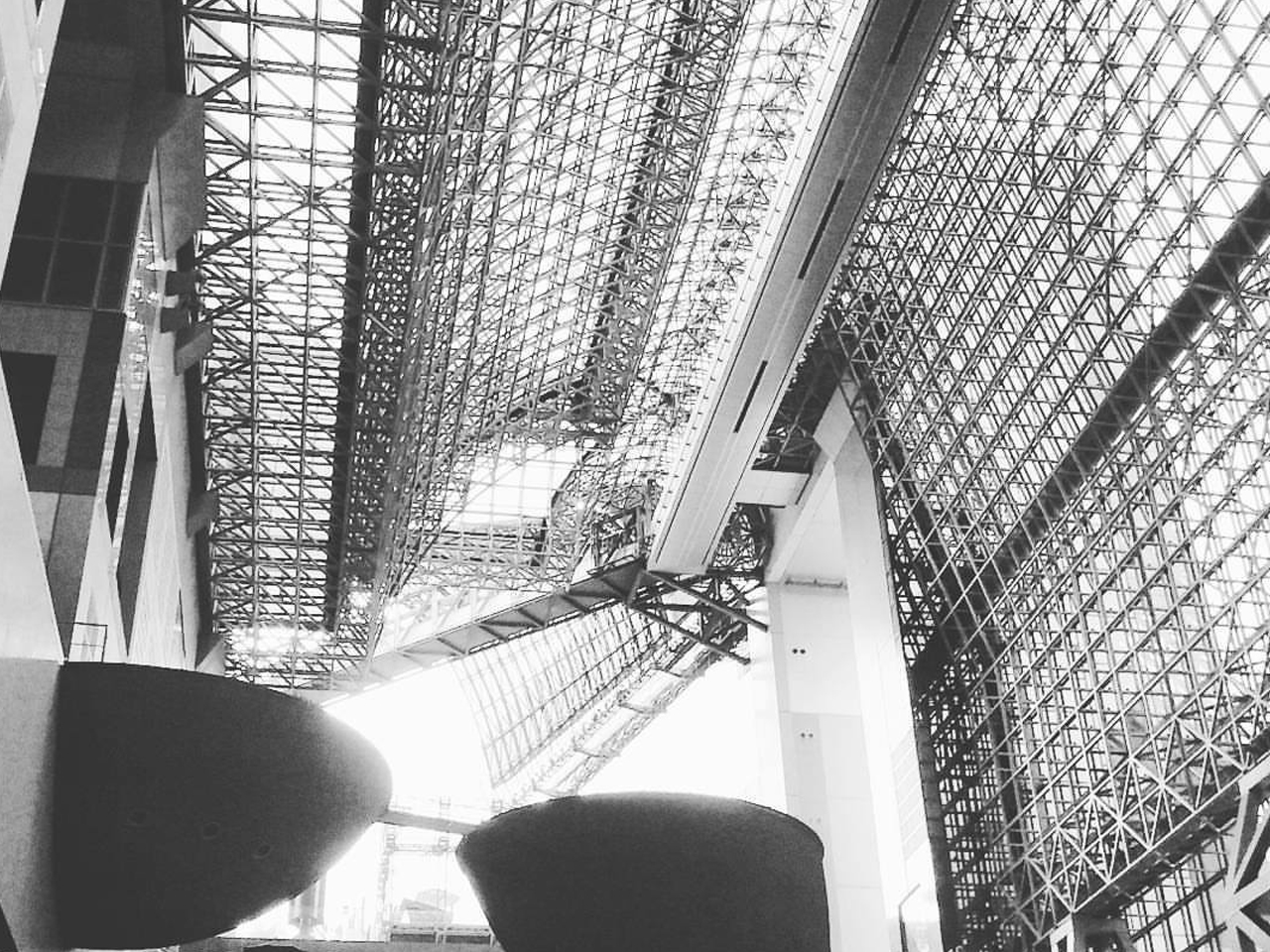
The next morning, Motoko was supposed to meet us at the train station around 10am. We told her that we would probably be going to Nijō Castle, which opened around 7am. If we woke up early and made the effort, we would have three hours to get to the castle, explore, and be back at the train station. I knew that between the jetlag and the baby keeping us up all night, that we’d never make it out of bed before 7am, let alone make it to the castle. Even more so, we’d be lucky, if we had time to enjoy the continental breakfast and arrived at the train station before 10 am.

We hit snooze on the alarm a few times and ended up waking up around 8am. We went down to the lobby for the continental breakfast, which was available until 9. There was nothing special about the food selection. There wasn’t a waffle bar or scrambled eggs, but we were able to get some pastries, cereal and juice. There was also coffee available and we both enjoyed a cup. We talked about the possibility of actually making it out to the castle and back, within the hour and a half that we had, even given the fact that it would probably take 30-45 minutes to get there using public transportation.
While we were eating there was a morning news show on the television in the lounge. Everything on the screen was soft and the graphics had rounded corners and circles. It seemed to be in contrast to how I usually see American television, full of sharp corners, boxes, and scrolling messages. Most of the people seemed to be smiling and positive, compared to the fear mongering that I feel like I see on American television. Maybe I am just romanticizing Japanese TV and I don’t watch American TV at 8am, so I don’t really have grounds for comparison.
In the end, went back up to our room after we finished eating, packed our bags, then left them at the front desk. Then we waited at the bus stop around the corner, for a bus that would transport us over to the train station.

When we arrived at the train station, we still had a little while before we needed to meet up with Motoko. We stopped into the Starbucks across from the train station to get another coffee, along with some tasty snacks for later. We went into the Yodobashi department store next door to the Starbucks. I wanted to walk around the store and see all the different household appliances. I was interested, if they had different items, that we might not have in America. We arrived at the section where they sell toilet seats. In America, you might see a few toilet seats at Walmart, made of various materials and in different colors. However, they weren’t messing around at Yodobashi in Japan. The standard toilets in most public places in Japan, have at least the buttons for the bidet and the seat warmer, but there were ones on the wall in this store that had things that you’d never think you’d need.

The cheapest seats had no functionality and were around $40, but there were some with lots of bells and whistles that cost up to $1500. I found one that I liked, which looked like it would be a steal at $250, but I couldn’t see myself carrying around a toilet seat for the next 4 days around Japan, then taking it back on an airplane. We ended up browsing a few more floors. Elizabeth picked up a sweater for Escher.
We went to the building next door, then went to the second floor. There was a tourism center and boutique where you could buy or rent a kimono. Elizabeth contemplated renting one for the day, and walking around town looking like a geisha. It was around $40 to wear one for an hour and take some photos in house. The next price point was $80 and that allowed you to rent the outfit for 4 hours and take it to different sites. I told her that I didn’t necessarily think that it was a good value for the amount of time, but that she could do it if she’d like. In the end, she agreed and decided to walk around in her regular clothes. We looked at the time and headed over to the train station to meet with Motoko.
Motoko was waiting patiently for us just inside the station, where we had met her the day before. We discussed our tour options for the rest of the day. We had originally planned to see a famous temple while we were in Kyoto, but because we did so much other non-sightseeing, the day before and we didn’t wake up early enough, it did not seem to be in the cards. Unfortunate an afternoon and a morning aren’t enough time to truly embrace all that Kyoto has to offer. One of the things that is impressive about Kyoto is the bamboo forest. It’s located about 30 minutes away on the JR line and there are lots of other sites nearby. Motoko suggested that we just skip the temples and go to the bamboo forest, then see what we run into nearby.
We took the train from the central station to what seemed like a fairly rural area. We were surrounded by green mountains and small houses. Unlike the night before, where we were plagued by the rain from the typhoon, the skies were clear. While it wasn’t warm per se, we were all comfortable wearing only a light jacket.

As soon as we arrived at the station and got off the train, it felt like we were in a completely different world from the one that we just left. We were in a quieter part of the city. While there were a few people walking around, it didn’t feel crowded and we hardly saw any cars near the station. We began to follow a path, which began only a few feet from the platform. We ended up walking by a museum called The Hall of the 19th Century, where there were a few old locomotives that we could see in a fenced in area. The museum appeared to be closed at the time, but it looked like it would be a cool place to check out when it was open.
We continued down the path, which seemed to be meant for pedestrians and bicycles, but would eventually, become a street with seemingly no traffic, which we walked down the middle of. We saw lots of little spots that felt noteworthy, but to locals seemed like everyday items that you wouldn’t notice. There was a small Buddhist temple called Kame Mineyama Heisei-in (亀峰山平成院) , which we stopped to look at for a moment. Motoko read the inscriptions that were visible in an area that was smaller than the lot of a tiny house, but didn’t make us think that it was very important.

Along the road we saw more little shops, where you could purchase or rent kimonos and get dressed up as a geisha for the day. We would occasionally see a girl all dressed up and walking around ready to take pictures, and Elizabeth would again contemplate whether or not she should do it so herself. The advertised price on the shops that we walked were about $80 per day to rent the kimono, and it was around $40 just to try it on and do a photoshoot, so we felt like that was the standard going rate.
We continued down the road, until it intersected with the main street. There seemed to be lots of tourists gathering ahead of us, going into shops and looking for places to eat. Motoko took us to the left, down the main street, then said that she was taking us some place for lunch. As were were walking, we looked inside the countless touristy souvenir shops, many of which had items displayed right next to the sidewalk. They were selling all variety of items, and Elizabeth started to get excited about buying a kimono or a rope to take back to the US. Every few stores she would walk in, so that she could try a few robes on, and couldn’t end up deciding. I tried on a male version, myself, but not only was it not really my style, but it was also a pretty high price tag.
In one shop however, there was a small drum, like the one that the villagers had in Karate Kid 2. We thought that it would be an amazing souvenir for our son, Hendrix. It was red on one side with black Japanese writing and a photo of the Togetsu Bridge on the other. The store was filled with lots of things made of bamboo, while I had hoped that the drum itself was made of bamboo, it was actually made out of plastic and shiny paper.
We continued to the end of the street towards the Katsura River. We had the option to cross, but we turned left at the river. Motoko took us into a shop, which had a restaurant on the second floor called Seisyuan on Sanjo Dori. The shop had souvenirs and candies, which we continued passed to get to a staircase in the back of the store.
Motoko went to the counter to talk to one of the employees to reserved us a table. We pushed the stroller toward the staircase and the gentleman that she was talking to went to recruit another worker to help us carry the stroller, with the baby up the staircase. The staircase was wider and less steep than some of the restaurants that we had been to, so it made it easier for us to walk up side by side. Even though, we anticipated more of a lunch crowd, when we arrived, the restaurant was maybe half full.
The space felt very open, as two of the walls were lined with windows, bringing in natural light. Under the windows were long low tables, that were raised a step up from the main floors. There were soft pillows for you to sit, on top of the woven reed floor. We were able to conveniently move the stroller into a corner, then Elizabeth laid Escher on a pillow next to her.

From where we were sitting, we were overlooking river across the way. We watched as tour groups arrived on buses and were guided across the long bridge. We talked to Motoko about her job teaching and her family. She explained that she started doing the tours, when her daughter started to get older and more independent, giving her more time to herself. The menu offered a la carte items, bowls of ramen or udon, along with rice dishes which included a bowl of miso soup. Elizabeth and I ordered a rice dish with miso, and Motoko ordered a ramen noodle soup.
We talked to Motoko about finding an artist somewhere where we could have our name written out on hiragana, with a sumi brush. Matter of factly, she explained that you could buy the brush and ink for a dollar each, then we could write it out ourselves. Then on a piece of paper Motoko sounded out our names, then wrote our names down using hiragana characters. We asked Motoko questions about how to pronounce certain words. She tried to correct us, even as we continued to not say things quite right. The characteristic that we kept noticing about Motoko was how easily she made the experience feel like we were hanging out with her as a friend, not just having her as our tour guide. Motoko really gave us the best experience to make us feel right at home in her country.
Our food arrived, starting with the miso soup, followed by the rice dish. Both were satisfactory, however, we continued to talk without really noticing whether the food was particularly delicious or not. After we finished eating, we carried the stroller back down the stairs, then walked back out to the road towards the river.

There were something of spiritually significant about walking across the Togetsu bridge, which which we found out meant Moon Crossing. Motoko walked with us over the raging Katsura River, which seemed like it had certainly increased it’s flow as a result of the typhoon. As we looked out across the river, into the mountains beyond, it was as if we were on the edge of civilization compared to the feeling we got when we were in Tokyo. It was a much slower life, which felt more quiet and natural. We arrived on the other side of the bridge in the Nakanoshima Area. We continued along the bank of the river on the small island for a bit, until Motoko checked her watch, and say that it was time for us to start heading back across to the mainland.
Continuing to keep us on task, Motoko guided us down the store lined street. Every few stores we encountered, Elizabeth would to stop in, in hopes of buying a kimono. Along the way, we walked passed a cat and owl cafe. You could drink coffee with real life cats and owls. I don’t know how it works, if they are kept separated, but do owls and cats get along? I know that they both eat mice, right, so do they let mice free and have them negotiate which one captures the mouse? Motoko said that cat and owl cafes are popping up all over Japan. While I have only heard of cat cafes recently in the United States, I haven’t heard of an owl cafe popping up.
After coming out of one of the shops, I remembered watching this documentary on Netflix about a sake brewery in Japan. In the documentary, they said that some of the best sake in the world is made outside of Kyoto. I asked Motoko, if she knew of a shop that sold sake that was brewed in the area. She asked someone at one of the shops, who pointed to the back of a grouping of outdoor shops called Arashiyama Shoryuen (嵐山昇龍苑).
We walked to the back of the small shopping area, where we found a well dressed Japanese man in a kimono standing behind a counter. In front of him, were island shelves full of different kinds of sake. Being prepared in case that people to want to taste the sake, the gentleman had a few bottles open and ready to pour. Unlike wine tasting in America, where you are paying $10 to try a few samples of wine before buying, this gentleman knew that he was going to sell me on something. He took me through four or five different types of sake.
Every taster that I drank was delicious. The cheapest bottle that he sold tasted 100 times better than the sake selection found in the US. Most restaurants serve a bottle of sake that is worth $1 and charge $10 for it. This definitely wasn’t happening here. What was truly amazing about the experience was that every bottle of sake had a story to it. The proprietor would tell Motoko the story and she would translate it to us. The bottles ranged in price from 1000 yen for a small bottle all the way up to 20000 yen for a liter of the best stuff. I ended up deciding on three bottles. One of them was a middle range type of sake in a small bottle. Another was packaged in a cool, small, bottle with a basket woven around it. The last bottle was designed with two white dragons wrapped around one another on the label. The proprietor told Motoko that the artwork on the bottle symbolizes success in relationships and family. With two babies, Elizabeth and I felt very drawn to this story.

We had our purchase fairly wrapped up, we had bottles in travel boxes, and bags. Then, like a pro, the proprietor took us over to a bottle of sake that he said was made for the Emperor of Japan. The price per liter bottle was 10000 yen. He told me that there were 250ml bottles that he would normally sell for 2500 yen, but since it was too expensive to open as a taster, that he would sell me the bottle for 1000 Yen ($10). It was an easy sell. We wrapped up one last bottle and I took a photo for good measure.
A few shops over, in the shopping center, there was a green tea ice cream shop, next to a crepe shop. Elizabeth and I took some time to indulge in a little of each. After leaving the shopping area, Motoko took us down the road to a Buddhist temple called Kōgen-ji, Tenryū-ji. As we walked, Motoko gave us a history lesson about the temple and the area around it. We arrived at a large main building which looked a little like a bar, then Motoko took us to the entrance of the sacred zen garden. Unaware that there was going to be fee to enter, I was a little surprised that it was going to be $25 per person. Since Motoko had a special tour guide pass, she was admitted for free.
After passing through to the other side of the huge wooden wall, you really start to see the work that goes into maintaining this level of beauty and quickly see where your admission fee is going. There were areas blocked off where the zen gardens were neatly raked. It was impressive to see the perfection in every detail of every bush, blade of grace, and rock that you saw all around you. The temples and shrines, as well as the intricately groomed flowers, mosses, and trees, really made you feel like you were in an absolutely divine place. Motoko explained that this garden had been around for almost 1000 years and that even ninjas and samurais came to this place in peace to meditate and worship.
On the other side of one of the buildings was a large pond surrounded by cherry trees; which in the spring must be a sight to see the pink flowers blossom. Even though it was autumn and the trees weren’t as full as they could’ve been, everything on the grounds was lush and green. However, there were trees that were changing into their fall colors and the beauty was breathtaking. We continued through the garden, and as we went passed some of the less groomed areas, we began to be surrounded by large bamboo trees. I had sort of thought that we were going to have to take a different route to the bamboo forest, but Motoko took us through the Kita-mon Gate of the Tenryū-ji. Then right on the other side was the famous bamboo grove. This made the whole voyage even more scenic and interesting than we had anticipated.
Motoko guided us up the path to where all of the promotional photos are taken. There we joined our fellow tourists as we walked through the massive bamboo trees, which seemed to reach the sky. The path was about a quarter of a mile long and took us up an incline. At the top of the hill, there was a one lane road and what looked like a gate. Motoko told us that a famous movie star from the silent era, who had made millions of dollars lived in this forest at one time. We couldn’t really see the house, but we were impressed nevertheless with the winding road that was built to give access to it.
We took the path back down the hill, and ended up finding a scenic pond, just before arriving at a historic Kyoto nature locomotive station. There were lots of people waiting to board the train and we stopped into the station for a second, before walking back to the train station where we were scheduled to depart from.
Along the way, Motoko had previously located a bookstore/gift shop/visitor center called Burari Arashiyama, where Elizabeth could quietly feed Escher before we got back on the train to the Kyoto station. The large building, where the store was located, was built and decorated in natural wood and had very high ceilings, which gave it a feel like we were in a luxury cabin in the woods. While Elizabeth and Motoko when to the back of the shop, where the nursing room was located, I sat at one of the picnic tables and admired the decor.
The End of Our Tour
When we arrived at the train station, Motoko informed us that she would be taking a different train back home, while we would be taking the train back to the Kyoto main station. In a very dramatic and emotionally charge departure, we said goodbye to Motoko. She showed us pictures of her husband and daughter, then told us that she would email pictures to us of the previous few days. She said goodbye to Escher, then gave both of us a hug, and then we parted ways. Motoko was one of those people that you never would expect to meet on accident. She was volunteered to take us on these tours and while I didn’t mention this before, she made sure that she planned all of the places along the way, where Elizabeth could nurse Escher. She called ahead to all the restaurants to make sure that all the places that we ate had a vegetarian option. She had a historic rundown of each place and made sure that she passed on her knowledge to us, even if we weren’t going to be able to remember it.
Elizabeth, Escher and I headed back to the Kyoto Station. Then I took the bus back to the hotel to gather our bags from the front desk, where we had been storing them for the day. Meanwhile, Elizabeth would find a place to sit at a restaurant, where she nursed Escher. When I arrived back at the station, the Kyoto Tower across the street was illuminated with bright green lights making the sky around it a neon green. I rode the escalator up to see Elizabeth waiting in the food court. We checked the train schedules and saw that we could take a shinkansen train to Shin-Osaka station, followed by a local subway to Namba station. Our airbnb apartment was located close by. By the time, we sat down on the shinkansen, it was already dark outside. We only needed to travel two stops before arriving at Shin-Osaka station, which only took about an hour. We gathered our things, then went to the subway level and took a train to Namba, about 10 minutes away.