
Day 4: September 5, 2015 –
We took the regional train to Coesfeld, and then boarded another train for one stop to the Rosendahl-Holtwick station. Overall both trains took about 90 minutes. As we got further from Münster, the view changed from that of a city to rural farmland. Once again, I began to reminisce of times of old, when I was growing up in Ohio. If my ancestors left Holtwick, Germany for America, only to end up in Ohio and Missouri, they weren’t looking for too much of a change in environment. I could hardly contain my excitement to see a place that I had dreamt of seeing my whole, entire life and meeting a German Holtwick.

When we arrived at the Holtwick station, Marko was already there to meet us. Marko is about 6’2 and built like a bouncer. He has a shaved head and looks like he could take anyone out, who stood up to him, but had a smile that let you know that he had your back, in case it was time to throw down. He said that he had been waiting for close to 2 hours, but he greeted us with the kind of patience and understanding, that you wouldn’t necessarily expect; given the German stereotype of demanding punctuality.
Münsterland is the “Garden of Germany” according to Marko and much like in the heartland of America; we found that he had a laid back approach to life, while maintaining the work ethic of a farmer or steelworker. We greeted each other with a firm handshake and a smile. Elizabeth took a few photos of Marko and I, then a man at the station, took photos of the three of us, under the Holtwick train station sign. Marko had driven, so the three of us got into his car. He looked up directions and drove us to the Holtwicker Ei (Holtwick Egg). As we rode the few miles down the road, Marko told us about his DJ experience. He explained how he got started and where he had been working lately.
As we made it to the city limits, it was strange seeing my last name everywhere. As I looked around, I could see Holtwicker restaurants, Holtwicker gas stations, and Holtwicker shops. In the past, when I imagined what it would be like to visit this place, I thought that it was going to be just one house and the Holtwicker Ei, but there were lots of brick houses lining the streets. Marko told us that he worked as a bricklayer in the 80’s and 90’s, and that he could tell how old a house was based on the type of bricks and the style, in which they were laid. As we drove past he pointed out different houses and then told us what year, he thought that they’d been build. He said that most of the houses were from the 80’s or 90’s, and that a few were from the 50’s. I guessed that, earlier than 50 years ago, it was really rural, with small farms, but had turned into an almost suburban, residential village.


By the time that we arrived at the Holtwick Egg, the rain had stopped and I was already regretting not bringing my video camera, to make a Holtwick documentary or my caricature stuff, to draw the townspeople. Because of all the rain that we had experienced, I thought that there would be rain all day, but I guess that I was wrong. It was only of those things that I was always going to regret, but I hoped that one day, I could bring my kids back to see where it all started.
The Holtwicker Ei is located at the end a hedge lined path, with a brick sidewalk. As you walked through to the end, there was a wide open space with a gigantic piece of granite. Every small German city has a legendary story, but the real story of the Holtwick Ei was that, it had been moved from Scandinavia by glaciers, thousands of years ago.
The stone was surrounded by a circle of bricks and the land raised around it was lined in grass. Surrounding the grass was another sidewalk and a circle of tall hedges which gave the stone a mystical feel. There was a group of children there, when we arrived, and I got a feeling of safety and comfort. I felt that if I lived in Holtwick, that this small park surrounded by hedges, would be my fortress of solitude. If I was depressed or needed reflection, this would be a place that I would go, like looking out into the Pacific Ocean during sunset. The whole area was very quiet and calming, and after the previous day’s stress in Hamburg, Holtwick, Germany became the cure for my soul.

As soon as I saw the huge boulder, my childlike instincts made me want to climb to the top of it and stand, arms raised to the sky, having conquered my fate, and finished my pilgrimage to my namesake. At close to 8 feet, it wasn’t an easy free climb, especially with my wet shoes and the rock, wet from the hours of rain. Marko tried to hoist me up and pushed under my shoes, but alas, I wasn’t able to make it further than a few feet. My attempts had covered my pants and jacket in dirt, but we took some photos anyway.
Marko read the signs marking the area and translated them to us, which told of the legend and the actual story behind the Holtwicker Ei. Then we asked him to tell us a bit more about his background, and how he actually became a Holtwick. He told us that his birth name was Hessel, but when he got married, neither him nor his wife wanted to change their name. So they flipped a coin, he lost the flip, and had to change his last name to Holtwick. He told me that in Dusseldorf, the name Holtwick carries a lot of power, because there was a wealthy CEO of a huge company, who was named Holtwick. He said that by changing his name, it actually opened doors for him in the business world. He said that he would get interviews for jobs, simply because he was a Holtwick.
The more we talked to Marko, the more we learn about how much he was dedicated to his kids. When things went sour with his wife, she basically turned on him, and became really strict about letting him see his children. She was also very strict about alimony payments and child support. Marko is a professional DJ and he manages and spins at one of the most popular clubs in Dusseldorf. He works long hours on weekends, typically from the evening, until the early morning.
The day that he met with us, he had gotten off work around 7am, slept for a few hours, and then met us in Holtwick. He said that, after he dropped us off, he was going to sleep for an hour and then go into work again that night. In order to follow his wife’s visitation schedule on a different weekend, he would have to be up 24 hours, in order to be able to see his kids. He worked with the courts and was eventually able to see them in afternoons on Monday-Thursday (on nights that he didn’t work so many hours) instead of on his busy work days, Friday-Sunday.
His ex-wife seemed like the stereotypical, strict and orderly German. Demanding everything be perfect and to her liking. Marko told us about his career as a musician and dj, the competitions that he participated in, and the hundreds of events that he performed at. You could tell that he was a perfectionist himself, in his own way, in order to be so successful in a field that isn’t typically an easy profession in Germany. Maybe that perfection was their initial connection, but years of conflicting schedules can take a toll on a relationship.
His ex-wife worked at a hotel and was in charge of the maids, so cleanliness was of utmost importance to her. Marko’s schedule hadn’t always allowed for him to be super tidy, so sometimes it became a problem when it came to seeing his kids. It seemed like his ex-wife didn’t want their kids spending time in a space that wasn’t spic and span.
You know the stereotypical football coach, who pressures his son to be the greatest football player ever? And basically puts so much pressure on the boy to be perfect, that he is afraid to try anything, for a fear of failure? That is how I imagined his wife being to their kids.
Marko told to us about how he placed 3rd in the best DJ in Germany competition and how he is one of the top party DJ’s in Germany. He is friends with the top hip-hop DJs, house DJs, and even coaches DJ’s, who need help with their skills. He has written and translated books from English, on how to be a better all around DJ. He also teaches classes and workshops to people of all ages, who are trying to be successful in the business. He said, that he spent years touring throughout Europe and was rated one of the top European acts in the 90’s. Now that he is in his 40’s, he really wants to settle down. He wants to focus on being the best father that he can be, and wants to be the full time manager at the club that he works at, or maybe become a fulltime teacher.
Marko and I thought a lot alike. We talked about how schools in both the US and Germany were focused on maths, sciences, and languages, and overlooked a student’s natural talents in other areas. We talked about the German school system a bit and how he was never a very passionate student. When he was 15, he saw a DJ spin at an event with his brother and told him, “That’s what I want to do for a living.” It was his dream, and with years of practice and passion, he made it a reality. Marko had always been musical. When he was in school, he played the flute and drums, in concert and marching bands, but now he prefers to have all the instruments on his macbook, because it’s less to carry around.
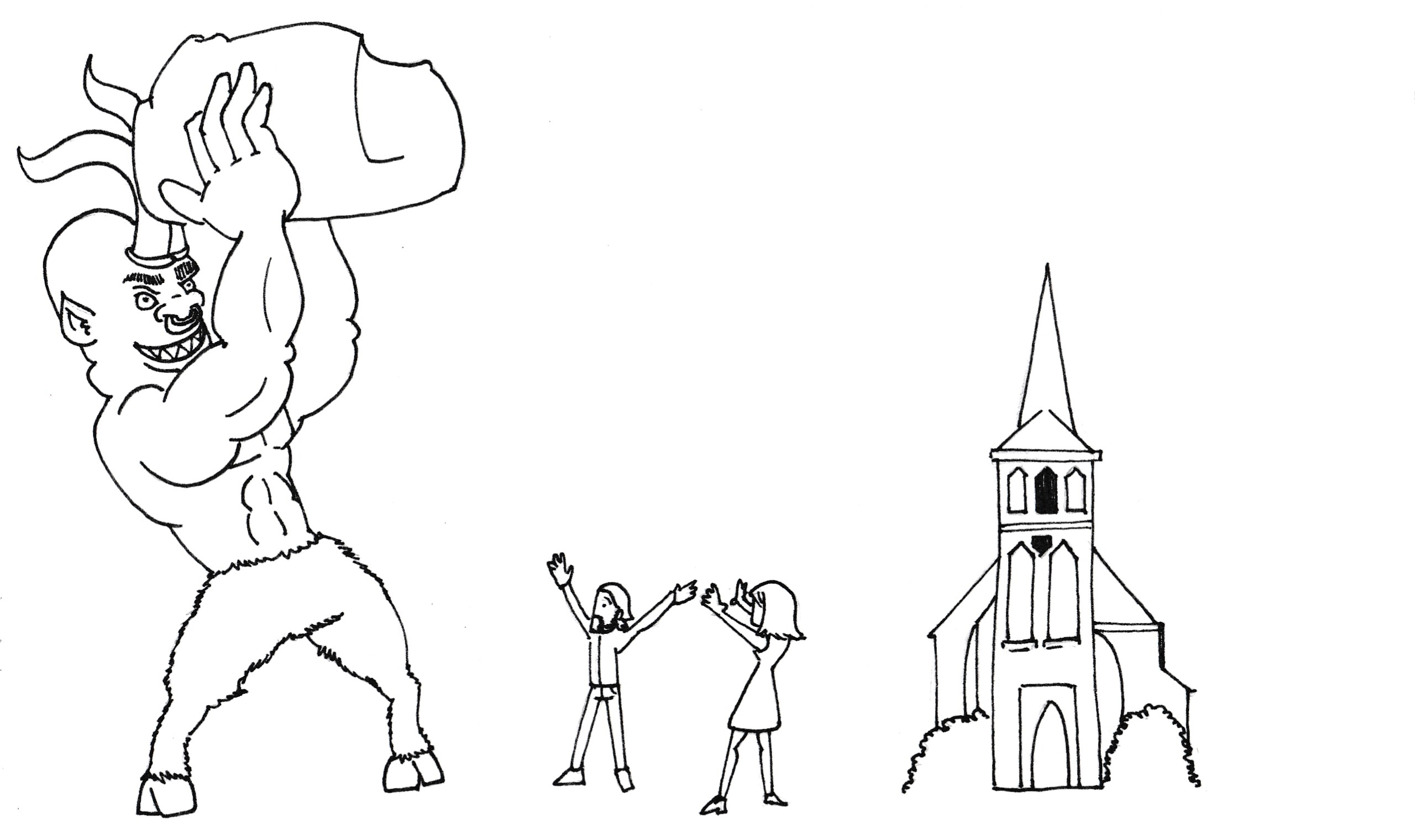
The legend behind the Holtwick Egg, is that the devil threw it, aiming to crush the St. Charles Church, but missed. Since we were got to see the Egg, we needed to see the church as well, while we were there. Marko didn’t know about it or where it was, so we stopped at a gas station and he asked the clerk. She thought it was strange that we had traveled all this way to go to Holtwick, but then gave Marko directions to the church.

The church was located in Downtown Holtwick, which was basically one street filled with a few small shops, which unfortunately were closed on the weekends. The same group of children that we had seen at the Holtwick Egg, was also roaming around the square and again, I wished that I would’ve been able to draw their caricatures. Being in Downtown Holtwick was thrilling. I had chills as I spun around the square, seeing the statues, hearing the church bell, and imagining what it would be like to see the city bustling with a crowd of Holtwicks.
We had one last stop in Holtwick and that was a visit to the Holtwick Haas, a Gatehouse that was build in the middle ages. At one point in history, there was a castle in Holtwick, but over time it had become rundown and was eventually demolished. The Holtwick Haas is all that remains of the estate and is now a meeting place for weddings and other receptions. There was a group of people outside talking and drinking, so we went inside for a self-guided tour. In the upstair, there was a ceramic pot on display, that was dated back to 900 BC, which was used by the first Holtwicks.
The group of people that had gathered that day, had rented the building out for some beer and dinner. Marko started talking to a gentleman, who was standing outside smoking, he laughed and was fascinated by the fact, that we had travel all the way from California, to visit their little town. While inside, I took some postcards, then walked outside to the garage area, where a carriage would’ve been parked. I asked Marko about the bricks in the walls to find out how old they were. He said that he wasn’t able to tell for sure, but he could tell which ones were original and which had been replaced.

Marko translated a bit of the historical sign to me that was hanging on the wall and I was able to learn a bit more about how long Holtwick had actually been around. Some time had passed and Marko needed to keep us moving, so that he could go to work. I took one last look around and took in the world around me taking photos and looking at the well across the yard and taking a deep breath as I walked towards his car. It was truly a spiritual experience, to think about where my people had come from and how I had returned to claim it in my heart forever.
After we left Holtwick, Marko had invited us to have coffee at his childhood home a few miles away, to meet his mother, brother, niece, and nephew. His mom lived in a townhouse, that Marko said was small for a family with 4 children. Marko’s mom was delighted to have us as guests and ran back and forth from the kitchen to the dining room table, like she was entertaining royalty.
She did whatever she could to make sure that we felt like family. She was exactly how you would imagine a German Grandmother to be. She brought out a box of assorted cookies, coffee, tea, and ham and cheese sandwiches. She didn’t speak English, so Marko would translate her German to us after they talked, but you could usually tell what she was saying based on the context. When she came in with the open faced ham and cheese sandwiches, she shouted, “Essen! Essen!” urging us to eat. Just like my mom, Marko says that when he’s losing too much weight, his mom tries to fatten him up.
Marko and his brother told us about how they were avid fans of the Bayern Munchen FC, the greatest soccer team in Germany. They always try to go to at least one game, and if they can they try to go to Champions League games.
His brother was really social and talked about how he has visited Florida and how he really loves it there. He was really excited that in a few months, he is going to Orlando and Miami with his wife and kids. They were going to go to Disney World and the beaches, and really make a great time of it. He pulled out his keys and told me that when he goes on trips, he likes to collect key rings from the places that he goes. There was one from Miami from his previous trip, which spun around, and there were ones from other places that he had been, around Europe.
With a big smile, he proudly pulled out a one dollar bill that he had brought back from his last trip. His son was in the other room watching television, and he and told me that his son was jealous that he had the dollar and wanted one for himself. It made me smile that his boy wanted a US dollar so bad. I wanted to do something special to show my love and appreciation to Marko and his family. So I looked in my money clip and saw that I had a dollar myself. I thought it would be funny and memorable if I gave his son, Max, his own dollar to spend, when he gets to Florida. The boy was watching tv, when I handed it to him and he was shy in taking it.
I think that I might have embarrassed Marko’s brother a bit, because he started laughing and turned bright red. I felt like I was doing something fun and didn’t mean any offense, but I sort of felt embarrassed for doing something that might have been socially unacceptable in Germany. I thought about having him do something to work for it, like a magic trick or solving a puzzle, but I couldn’t think of anything at the time.
Marko’s brother told that one of his favorite shows is CSI: Miami. I laughed and then I asked him, if he liked Miami Vice. He smiled and said that he had a Don Johnson style, white sport coat. I laughed and shook my head, because I could imagine a guy walking around in Germany with a jacket that probably still stood out in the 1980’s. Marko checked his watch and told us that he had to get us back Münster because he had to drive a few hours for work. I was a little sad to have to leave, because I really did feel like I had a new family. Even though they were the Hessel’s and not the Holtwicks. I could see love and camaraderie in their eyes, and that something that I don’t always see from my actual relatives. Marko was an amazing tour guide, host, and new friend. He is one of the most amazing people that I ever met and I felt inspired by having met him.
As we were drove back to Münster, we all talked a bit more. Marko told us that he was ambidextrous and did sort of a “Wax on, Wax off” move. Thinking that was hilarious, I asked him if he liked the Karate Kid. He said, that he bought the movie for his son on DVD and his son became obsessed with it. While some kids become obsessed with Disney movies, this kid was hooked on Mr. Miyagi and Daniel LaRusso. Marko said that he record clips from movies onto a CD that he keeps in his car. They are inspirational quotes from movies like Rocky and the Karate Kid, and sometimes they will listen to them together when they are driving around.
Marko said that the Karate Kid teaches good values for teenagers and teaches them about hard work. He said, that his son wants to be a policeman, but he also wants to be rich. Marko told his son, that he will have to work really hard, if he wants to be a policeman, but if he wants to make a lot of money, he has to be a salesman. He said that his daughter loves Barbie and wants to be like her when she grows up. His ex-wife’s pressure on her for perfection in school, has caused her to not be able to have confidence in other activities that she is involved in. Marko said that because she is so hard on her to succeed and criticized every mistake, his daughter is afraid to swim. She looks at the water and can’t jump in, because she doesn’t believe in herself.
When we were close our stop in Münster, we asked Marko about his dad. Marko told us the story about the day his father died. He said that his father had cancer and heart disease, but he didn’t want to die at a hospital. He wanted to die in his bed at home. Marko’s sister and niece have a birthday the same week, so his parents and his family get together every year to celebrate. In 2012, they all planned to get together. Marko and his siblings said, they felt that it might be the last time, that they would see their dad again.
His dad wasn’t feeling great, but he and his mom traveled out and saw the family anyway. Marko said, that they all had a great time. On the ride home, his mother was driving and his father went to sleep, but never woke up. It was touching that the last day of his father’s life was with his children and grandchildren, and I held back my emotions as I thought about my own family. Even though his father was weak, he made his wife drive him out to see the family, so that she wouldn’t come home to find that he had passed, while she was away. Marko said that you can die at anytime, so [death] shouldn’t keep you from doing things. And there is no reason to worry about things, because you know that you are going to die anyway eventually.
