
We set an alarm to wake up around 7am. Elizabeth was still mostly asleep, so I told her that I was going out for some breakfast and that I would be back soon. The rain had started up again. The streets were still empty and just like the night before, everything was closed. Even the breakfast places were still closed. I ended up going back to the convenient store to get some energy drinks, snacks, and a coffee for Elizabeth. I stopped at the bus stop to check the schedule. There were buses leaving at 8:05 and 8:50. I went back to tell Elizabeth, then she slowly got into the shower and began packing up.

We wrote down the number for the electronic keypad, which was printed on our key, then I dropped our key into a small mailbox. This was essentially us checking-out. We stowed our luggage into the small closet, where we were instructed to put our luggage the day before, minus our valuables. We then walked over to the bus station. We still had the tote bag that contained Elizabeth’s computer, my tablet and a few other items, and I planned to stop in at the lockers in the bus station to drop them off. There was a line at the bus stop and as I started walking over to the bus station, the bus arrived. I ran back over to Elizabeth and Escher. I got on the bus with them, because the next bus wasn’t leaving for another 45 minutes. I knew that it wasn’t wise to carry this bag of items along with my backpack, while we were walking through the rain, but at the same time, what were we going to do for the next 45 minutes, if we didn’t leave on this bus.
I was frustrated that the rain hadn’t let up and that I was going to be carrying extra bags all day, but I shook it off. We arrived at the first bus stop, where the famous red Shinkyo bridge of the Futarasan Jinja Shrine was located. We exited the bus and began to look around.

Outside the bus stop, there was an old phone box and I told Elizabeth to sit inside. She was reluctant to do so, even for a quick photo op, because I had just been complaining about carrying the tote bag and that had soured her. We did manage take a few photos before rounding the corner and taking a closer look at the bridge. From what I could tell, crossing the bridge was meant to bring good luck. There was a ticket booth next to the bridge and they charging people 800 Yen to walk across. For hundreds of years, only messengers of the Imperial Court were allowed to cross the bridge, so who were we to break tradition. I didn’t think that we needed to pay for the luck, but I watched a couple pay to walk across the bridge over the Daiya River. We decided to cross the modern bridge a few feet away for free.

At this point, we had to decide whether we were going to check out the historic shrine and temple park of Nikko up the staircase ahead or follow the river and take a small hike down to the Abyss. While in retrospect, we thought that going to the Abyss first would be better, because we might be too tired later to go on a long hike. We would however find that the crowds at the temples would be massive throughout the day, even during the torrential downpour that we were currently experiencing. We followed the road signs that pointed us in the direction of the Abyss. Along the road, we discovered a Family Mart across the street. We jogged across the wet, slippery road to avoid traffic, and made it safely across. Elizabeth wanted to grab a hot coffee and I had to use the restroom, so I went to the back of the store, while she stood at the counter waiting.

I pushed the door and it didn’t move forward, so I thought that it was locked and someone was inside. After waiting a few minutes, I gave the door a little push, but still nothing happened. Maybe 10 minutes passed and I wondered what could be taking this person so long. I grabbed the handle and moved the door, finding out that it was a sliding door all along, and that it was me who was too inept to figure it out. When I ended up getting done and going to the counter, Elizabeth wondered if something was wrong, and why was I in the restroom for so long.
Now that we were both prepared, we continued down the road along the river. We veered to the left, which took us off the main road and down a residential area. The other side of the river was lined with tall trees that seemed to go up the side of a hill for miles. Each set of trees presented us with different fall colored leaves. While the rain still fell with a mighty force and began to dampen our attitude, it was still a beautiful sight, which reminded us that we were back in nature. At the beginning of the trail, all of the houses seemed really narrow and stacked. Some had luxury cars locked up behind electric gates below. The further we went down the road the larger the houses became. Still following the signs to the abyss, we took a bridge across the river, then continued down a road lined with small houses with large front yards.

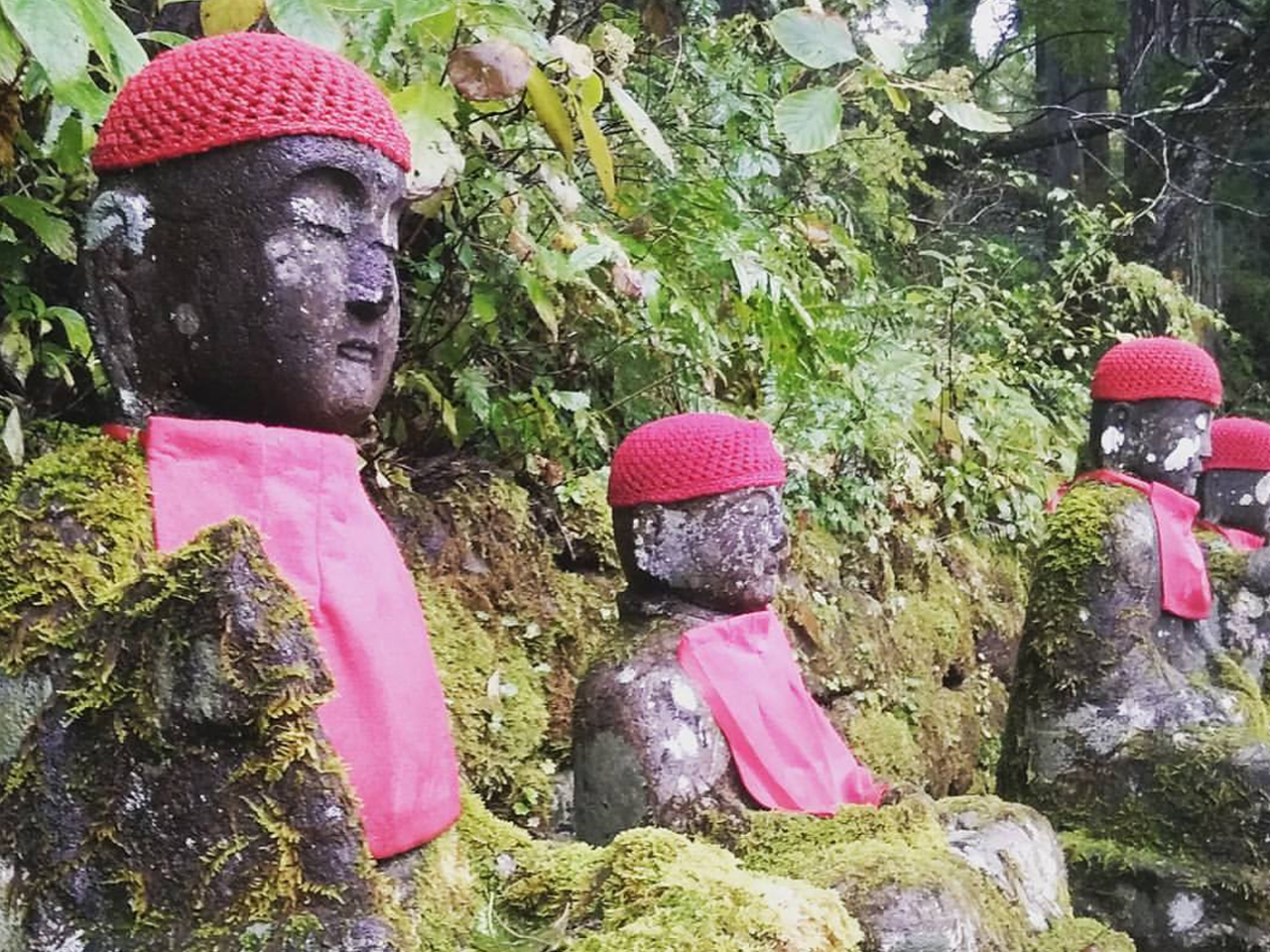
I commented on the fact that while there wasn’t a store around, there was a vending machine selling soda, juice, coffee, and beer every few houses. I guess that if you lived nearby and didn’t want to get in the car to go to the shop, you could just walk to the end of your driveway and grab a can of coke. At the end of the long road, there was a hostel followed by a small park, where the actual trailhead was located. There was a small statue with a red hat and vest in front of a pagoda, which marked the beginning of the hike. We walked through an open area surrounded by trees, before walking under a large shrine, where it was like we were once again all alone in nature. We followed the trail, along the strong flowing river, where we were slightly protected from the rain by the trees above. We arrived at a small white building, that was the only thing between us and the long line of statues that one might mistake for Buddhas wearing matching knit red hats and knit red vests. The statues were about 18 inches tall, and carved out of stone. While one might think that they were made identical, but each one was slightly different. Some were short and fat, some were a little taller and skinnier, but all of them had similar faces. I wondered, if every statue represented a different person or if it was an interpretation of the same person. When someone died, were they immortalized with a statue?
On either end of the long line of statues, there was a staircase carved out of stone. We walked up the staircase to find green everywhere. We entered what looked to be a cemetery. There were carved headstones that ranged from 3 feet to 5 feet in height. All of the stones were covered in green moss. As you looked around the surrounding trees to the stones in front of you, it was green all the way across. It was amazing how much green there was around us.


We walked back down the staircase, then after taking some time to relax on the porch of the white building, we walked back along the trail and through the forest. The rain was still coming down pretty hard, but at this point, we didn’t seem to mind as much. We arrived back at the trailhead, then followed the street until we arrived at the unnamed bridge, which took us back across the river.
There were some younger people walking ahead of us, who were pulling luggage behind them, so we thought, “They must be heading to the nearest bus stop, we just should follow them, in case they know a shortcut.” We deviated from our course, which would have taken us back the way we came. But we ended up following people, who started to take us in the opposite direction of our destination. We broke free from other tourists and continued to the main road. We turned left and began to head towards the historic temple district.

We continued passed the Family Mart, where we had stopped earlier. Then once again we arrived at the Shinkyo bridge. We crossed the street, then walked up the steep stone staircase up to the temples. We wanted to stop from getting wet for a little while, we both had to go to the bathroom, and Elizabeth had to nurse Escher, so we luckily happened upon at a little teahouse called Hongu Cafe. The cafe was built in the middle of the woods, near the Hongu Shrine. It was an interesting spot, and we wondered how you would get a permit to build in the middle of the national park, however we embraced its location as adequate shelter from the storm. Our feet were completely soaked. As we sloshed up the staircase, we saw that this was an establishment, where our shoes needed to be taken off outside and placed in cubbies before entering. This seemed like more of a disservice to them, than a courtesy to us, but we complied. Inside the door was a rack of slippers, which you could borrow, while you walked around the teahouse. We happily borrowed them as to not track moisture from our sock around the room.

We went to the hostess counter, where a young woman was standing smiling. After we approached, showed us to a table near the back of the seating area. The whole space was dimly lit and cozy, which felt comfortable after being out in the rain. It was almost like we were in a log cabin in the middle of winter, warming up by the fire after a long journey. After I sat down, there was a window behind me that looked out into the woods. Elizabeth sat across from me and watched the raindrops as they soaked the leaves on the forest floor. Our menus looked like handmade books. Each one was handwritten and the food items were accompanied by little drawings, like the task was commissioned out as a school art project. There were only a few food items on the menu, but clearly their specialty was hot matcha green tea. We saw a few other people around us who were eating clam chowder, which was the special of the day. I, however, am not really one for cream soups, so stuck with only drinking the tea.

While we were sitting there flipping through the menus, two French women were sat down at the table across from us. I couldn’t really tell what they were saying, but it was amusing to hear someone speaking in a language other than Japanese or English, especially since it was French. Much to my surprise, the tea house was quiet and peaceful, perfect for a rainy day, and Escher remained relatively quiet as well. Elizabeth secretly nursed him at the table, while I warmed up with the delicious tasting tea. In the moment, I was anxious to get out and see the temples, which were part of the reason for our travels to Nikko. However, I would find that it might have been more enjoyable in the long run to drink tea for the rest of the day, instead of walking around in the rain.
Before we left, I went into the restroom. Above the sink was a window sill and a frosted window. For whatever reason there were about 4 or 5 little Star Wars figures displayed and a sign in English that read, “Do not touch!”. It was interesting to see such a display on the window sill in the bathroom, but more interesting, they were assuming that someone that read English was going to disrupt the figurines.

After we finished our tea, Elizabeth and I paid the bill, then put our slightly drier feet back into our wet shoes, where they were wait for us on the porch. After walking down the cafe’s steps, we continued up a long staircase of stone that was covered in green moss. In some ways, it looked as though it served as a route for water to travel down the hill like a decorative waterfall in addition to easy transport through the woods. When we reached the top of the staircase, we arrived at the space where the Rinnoji Temple or Sanbutsudo (Main Building) was located. Due to the fact that it was under renovation, it was covered in a giant corrugated steel building. You could enter the building while the temple was under renovation, but it required an additional fee. We continued past some private residences, which were so beautifully decorated with shrines and interesting landscaping, that they looked like museums in their own right. Luckily, there were signs indicating that they were private residences, because some of the large wooden gates to the houses were open. I could easily see inquisitive tourists walking in like they owned the place and taking photos of every little fountain and bird bath.

We arrived at a wide open pedestrian walk that was about 100 feet wide and covered in gravel. There thousands of people were gathered in this area who were there to see the sights. We followed the gravel route up the hill towards the temples. Part of the way up the hill we saw a parking lot with about 10 tour buses, supposedly responsible for transporting all the people who we were seeing around us. It was incredible that even as the rain continued to fall, the crowds were comparable to a sunny day at Disneyland. This made me wonder how crowded the park was when the weather was actually nice out and not threatened by a typhoon.

As we walked up a little further, I saw a sign for restrooms and lockers. I was getting tired of carrying my full backpack along with the black tote bag, so I told Elizabeth that I was going to lock it up in the locker. There was a temple that was decorated similar to the Rinnoji Temple, which would be similar to other temples that we would encounter. On the front of the temple was a line of shops where you could purchase items to give as offering as you prayed to the god that was being represented. At the end of the line of shops, there was a man painting kanji characters with a sumi brush and selling them to tourists. I told Elizabeth that I was going to walk over to the lockers, then she told me that she would wait right there for me to come back.
I followed the signs which took me up some stairs and across the outside of the corrugated metal building containing the Rinnjo Temple. On the other side of the metal walkway was a little pond and garden, with a little shrine in the middle, which sat peacefully like a little piece of paradise within a larger paradise.

I arrived at the building where the restrooms and the lockers were located. Then I entered the locker room, which was only about 5 feet across and 10 feet long. There was a bench under the windows across from the lockers and sitting there were two Japanese women, who were talking. As soon as I walked in, they stopped and they looked up at me, like I was interrupting. I put the tote bag in the locker, then locked it up to leave the ladies to their business. I walked back up the stairs and along the backside of the Rinnjo Temple. I arrived back where the old man was painting the kanji characters with the sumi brush, and Elizabeth was gone. I slowly walked passed the little store fronts and peeked into the temple to see if she was inside. I walked back out into the wide path, that lead up to the trails. I looked up and down the hill to see large crowds of people in either direction. Shaking my head I thought, “She said, that she was going to be right where the guy was painting. How am I going to find her in this madness?”

I walked back over to the shops and still I didn’t see her. I stood around for another few minutes, then I saw her from across the crowd walking along the metal bridge around the Rinnoji Temple. “Sigh, I thought that she said that she was going to wait right there,” I thought to myself. I followed her back around the building and saw her going down the steps. As she arrived at the locker room, she turned around and started walking towards me. “I thought that you were going to wait by the guy painting!?!” I said. “I was. You walked right passed me!” She said. “Well, you’re not there waiting now and I didn’t see you before.” I replied. We bickered for a few minutes as we continued past the stores, then together we continue up the hill to the temples.

The further up the hill we got, the more people seemed to be gathered. It was still hard to believe that even during a typhoon, which surely would’ve turned some people away, there was still hundreds to thousands of people lined up to get to the pay area of the park. Even Disneyland is less crowded when it rains, I thought.
I joined the line up to the ticket booth where I waited to purchase tickets to enter the special fee area. Tickets in hand, we entered single file up a ramp and through a walkway. On the other side of the main gate was a series of temples going from left to right. The ground had been divided into areas where there was loose gravel while other areas were large blocks of stone. While I thought that perhaps it was breaking a sacred law to step on the gravel, every once in awhile someone would walk though. I assumed that the gravel area was meant to be maintained and raked like a zen garden, but perhaps due to the weather, an exception was being made.

Even though the rain was coming down harder than before I still took out my camera and tried to shoots some video. I didn’t have a steady hand while holding the umbrella, but I was still trying to see if I could get some shots that I could edit together for a mini documentary.
There were tour guides that continue filling people in front of the Tōshō-gū shrine, where the famous Three Wise Monkeys (hear no evil, see no evil, speak no evil) were carved out of wood in relief along the horizon trim. This shrine was supposedly origin of the monkey imagery. All along the trim of the building were other curious images, which told the story of a man’s life. While beautiful and detailed none of the carvings was as familiar as the Three Wise Monkeys. Lots of tourists were similarly taking photos and videos, but what was truly incredible was the amount of umbrellas opened in one space. Most of the umbrellas were clear, most likely purchased for a few hundred yen at a 7-11 or Family Mart, just like ours, but occasionally there would be an opaque colored umbrella standing out.

I started to have a real duality about how and why I captured photos. While I wanted to take photos of things alone with no people anywhere, just showing the building or the statue or the artwork, taking a photo with the people present actually captures the moment as it is happening. When I tell the story of going to Nikko to see the Tōshō-gū Shrine, I want to tell the story of hundreds of umbrellas everywhere you looked, and a photo depicting an empty space might imply something different. It might almost make it seem like you weren’t even there, because a specific time could not be determined.
Elizabeth and I talked about how we thought that we should have gone to the Abyss first, so that we could feel isolated in the space. The rain would surely keep people away from the shrines, we thought. Now that we were in moment, we saw that maybe we should’ve come here first. We slowly walked with the crowd up a steep staircase and through a different gateway. This staircase lead to a large temple, which you could actually walk inside and look around. It was also surrounded on all sides with other shrines and was lined with the similar loose gravel and stone ground. All of the shrines were carved with intricate designs and bright colors. The reds and golds seemed to illuminate around us especially since we were surrounded by gray skies.

To the right of the Tomon was a walkway, followed by a huge stone staircase up. The staircase seemed endless, as it felt like we were going deeper and deeper into the woods. When you looked up at the treetops, which towered above, you could see wooden braces that connect them together to prevent them from swaying too much in the wind. The trees were so tall and old, that I couldn’t imagine one falling. If one did, it could be disastrous for the temples and shrines. The scenery felt like it was straight out of Return of the Jedi, when the main characters were on the forest moon of Endor. It wouldn’t have seemed out of place, if an ewok came swinging across a rope in front of us.
The further up the staircase we went, the more that we were worn down. We were getting colder and wetter. Escher was also weighing Elizabeth down, as he was still in the Ergobaby carrier. When we finally reached the top, directly in front of us was a line of bottled green tea vending machines. There were 5 of them all in a row and they didn’t supply anything else. Conveniently, however, if you didn’t have cash you could use your Pasmo card. I could imagine that in the summer, when the humidity is 99% and it’s over 90 degrees, the machines are like an oasis in the desert, but at the time, I think that Elizabeth would’ve loved a hot coffee. There were benches under an awning, where Elizabeth took a seat to get out of the rain. Not wanting to make it all the way up to the top and not see what all the fuss was about, I went up the last couple steps and toured around a walled off area called that Kanosugi. It looked like there was a shrine of some sort, of a cat and a crane. I wasn’t sure what the significance was, but it must’ve been special to have been so far up the mountain, in the middle of the woods.

As I came back around, Elizabeth asked me what I saw, I could only explain that it was bronze sculptures of a cat and a crane. I told her that she should take a look, but she didn’t seem bothered to get up. Her energy level was way down and it was at this point that we were going to need to wrap up our Nikko tour and head back to Tokyo. I sat down on the bench next to Elizabeth and Escher surrounded by other tourists, who were trying to get out of rain for a few minutes, before heading back down the staircase.
I noticed that there were multiple fountains around the historic area, where there was water flowing and a ladle. I would see people pour water on their faces or clean their hands or just take a drink. There was also a box with coin slots on the top of it, in front of the fountains. I saw one gentleman come up to a fountain after reaching the top of the steps. He put some coins in the slot, then bowed, and simply put his fingers in water and dabbed his face. It appeared that he was saying a pray, then giving an offering, after which he blessed himself with holy water. When I saw this, I really felt like we were in a special religious place, with spiritual significance. Even though it felt like we were being wrangled like cattle, pushing every seam, there were people here to worship and find peace. It was almost as if this gentleman was at his church and we were just coming in and taking it for granted. In spite of the rain, the space was peaceful and calming, giving you a true sense of humility and appreciation for the earth and its beauty.

Once we re-charged our batteries a little, we headed back down the stone staircase, back through the forest. When we arrived back to the lower level of the temple grounds, where we saw a group of people removing their shoes, before going around to enter a large building. We figured that it couldn’t hurt checking it out ourselves. There were a couple hundred cubbies, where people placed their shoes. As each tour group arrived another were departing and a large replacement of shoes would take place. We made sure not to step on the sacred walkway with our shoes, like some of the other less respectful tourists. After our shoes were stowed away, we followed the crowd on the bright red-orange platform, then under a covered area to the front entrance of the Tomon temple.
We climbed the steep staircase, then entered through the large doorway, which easily looked 30 feet tall. There was a gentleman performing a religious ceremony in Japanese, which everyone watching and listening to, while kneeling and sitting on their feet. After going through a long explanation in Japanese, he began to do what I interpreted as giving a pray. In order to get the full experience, I joined in with the crowd and said a prayer myself. I’m not certain, what his prayer was for, but it seemed like most of the prayers and spiritual items in this religious area focused on success in business and success within your family. I prayed for a little of both.
Everyone rose at the same time and we were brought along to the back of the room. The back wall was intricately carved out of wood and painted gold. We passed another coin slot, where I put in another few 100 Yen coins, for good luck. As we were brought back around to the front of the building, we were taken to a little gift shop area. There were lots of different spiritual items, statues, posters, and postcards in glass cases. Behind which there were sales people selling these items. Elizabeth had been a fan of collecting postcards on our trip, so she purchased a small box containing an assortment of postcards depicting sites in Nikko.

We walked back down the stairs and followed the walkway to the cubbies. We put our shoes back on, proceeding to exit through the gate, then down another staircase. We stopped and took a few more photos, as there seemed to be less people in the area than there was previously. We walked over to another gift shop that was next to the building where the “Three Wise Monkeys” were carved. There were a number of different items up for purchase, but what stood out were these small, rectangular, wooden tiles. They were about 4 inches by 6 inches, and on them were painted different animals. They had a Chinese Zodiac chart (not that I really thought that they were related), but apparently you could purchase a tile that was associated with your birth year. The art style that was painted on the tiles was different from the styles that were present in the shrine area, but Elizabeth and I thought that they were aesthetic, so we picked out the tile with an artist’s interpretation of the “Three Wise Monkeys”.
We were considering leaving the park all together, getting some dinner outside of the park, possibly near the train station, but Elizabeth wanted to eat sooner than that. We happened upon a gift shop called, Kishino just down the hill from the shrine area where we just were. We walked in to see if there were any items that we wanted to purchase. After looking at multiple waving cats that were out of our budget, we noticed that they served food in the back of the gift shop.
There wasn’t a hostess, so we sat ourselves at the only open table, near the waitress station. Someone came over to us right away, then we asked if they had an English menu. The menu was pretty simple, only a single page of items. There were only about 7 dishes, 6 of which were vegetarian, which was a bonus for Elizabeth. The 6 dishes all contained soba, which was a popular source of protein in the region. Eating soba had dated back to the time when samurai and monks were living in the area. The one meat item was a pork curry, which I ordered, while Elizabeth chose one of the soba dishes. The food came rather quickly and while it was edible, it wasn’t really as tasty as I would’ve wanted at the time. Elizabeth said that her dish was really good. She always orders delicious food.

After we were finished eating, we opted out of hiking deeper into the forest to see more shrines and temples that may lay beyond. We instead decided to walk back to the locker room to retrieve the tote bag, then take the tour bus back to the hotel and train station. We decided to walk around the front of the corrugated metal building, where the Rinno-ji Buddhist temple was being restored. We walked up to the ticket window to see the entry cost, which ended up being more than we thought we needed spend after all of the sites that we just experienced. When I arrived the locker room to get the tote bag, much to my surprise, the same two ladies that were sitting on the bench before, were still there talking. I guess that they were trying to wait out the rain? Or maybe they just couldn’t leave until the bus driver was ready to leave? Either way, I found it strange to find them still there a few hours later.
After I retrieved the bag from the locker, Elizabeth, Escher, and I headed back down to the main road retracing our steps from the way that we came. The rain had let up to a light sprinkle at this point, but the roads and trails ahead of us were pretty much empty compared to how they were on the way up. Maybe the rain had scared some people away, or maybe they two were already heading back on the train. When we arrived the bus stop, there was a line of people waiting. Only a few minutes later, the bus arrived. We got onboard and road it back to the Tobu Bus station. Elizabeth walk into the bus station lobby with Escher to wait, while I walked back over to the Tobu Nikko Lodge to gather our additional luggage. I went in through the side door, using the code from the keypad, then upon retrieve our luggage, I headed back across the street to the bus station.
The JR train station was about an 1/8 of a mile down the road from the bus station. Elizabeth suggested getting on a bus, even though I was carrying the luggage, the stroller, and my bag, so we ended up just lumbering down the road. When we arrived at the train station, there was a train that was already waiting. We started walking through as we had before, but the female ticket taker stopped us as we tried to show her our pass and walk through the gate. She asked where we were going. I told her that we were going to Utsunomiya and then to Tokyo. She told me that the next train to Utsunomiya wasn’t for another 45 minutes and that I would have to wait. We walked over to the waiting area, that contain benches and lockers, then set our stuff down. Seconds later, Elizabeth disappear with the baby. I looked on my phone to see if I could plan out the rest of our route to Tokyo. I found a few high speed rail trains leaving from Utsunomiya within the next few hours. I went up to the JR ticket window to see about reserving some seats on the next one leaving for Tokyo after we arrive at Utsunomiya.
There was a printed sign posted on the window saying that all of reserved seats on the next train were sold out. I asked the ticket vendor, if he thought that there would be seat in the unreserved cars and he made it seem like there wouldn’t be. I reserved a couple of seats on a train that would leave about 45 minutes after we arrived. I thought that would be enough time to get a snack and reboard the train without us waiting at the station for too long.
I sat waiting on a bench in the station lobby, which was virtually empty and I noticed the repeated message over the PA system. The message was in Japanese, but I recognized the word Nikko, which was the name of the city. It would repeat about every 2 minutes, and started to become rather annoying about about the 5th time. Elizabeth eventually came back with Escher and I told that I purchased the tickets. Time went by quickly as usual and I only noticed the time when there were only a few minutes until the train was schedule to departed. We rushed to get everything together and get through the ticket gate. When we got onboard, the train slowly filled, but still remained fairly empty, by the time we were on our way. After the hour train ride, we arrived Utsunomiya, where we went to grab some junk food, before heading down to the shinkansen platform.
I messaged the woman that was renting out her apartment to us as an Airbnb, to let her know what time we were arriving. She replied in Japanese and AirBnB translated it as basically, “Be safe during the Typhoon.” We arrived at the Shinjuku station about 2 hours later. When we left the platform, then went down to the station concourse. It was crazy how many more people were around us, than there had been over the last two days in Yudanaka and Nikko. It was already about 6pm, so people were getting out of work and commuting home. As we arrived at the concourse the bright lights and speed of the crowds power walking in front of us felt a little overwhelming compared to where we had come from, and you could tell that we were back in the big city.